
Quick Summary
Addressing water damage restoration in Flushing requires immediate intervention to stop lateral moisture migration across shared brick party walls and prevent dangerous mold growth within 24 to 48 hours. Floodline Restoration Co. delivers specialized local emergency relief with guaranteed 45-minute on-site dispatch, infrared thermal mapping, deep masonry cavity drying, and end-to-end insurance claim management. Property owners can call the 24/7 live dispatch line immediately to secure rapid 45-minute arrival, a free visual inspection, and seamless mitigation through complete structural rebuild.
Water Damage Restoration in Flushing – Fast 45-Min Relief
When clean water lines break or municipal sewers back up into your property, you need an experienced crew on-site immediately. Floodline Restoration Co. deploys IICRC-certified technicians across Flushing within 45 minutes to stop active flooding, extract standing water, and coordinate your insurance claim from the first call through final repairs. Pumping out visible water is only step one. In Flushing’s attached brick row homes and multi-family properties, water travels sideways through shared party walls and soaked subfloors, rotting hidden structural timbers and triggering mold growth in as little as 24 to 48 hours.
Basic carpet blowers and standard contractors cannot pull moisture out of dense masonry or recessed joist pockets. Our Queens emergency response team arrives with commercial moisture-mapping tools, low-grain refrigerant (LGR) dehumidifiers, and negative-air containment systems to handle clean water leaks and contaminated black water backups alike. We never hand off your job to third-party subcontractors or leave you stuck in automated phone loops. Call our 24/7 live dispatch line now for guaranteed 45-minute on-site arrival and an upfront visual inspection before moisture weakens your building foundation.
What to Expect During Professional Water Damage Restoration
Restoring a flooded property in Flushing requires fast extraction, detailed thermal moisture mapping, antimicrobial treatment, and structural drying. Because local buildings sit over high water tables and frequently share structural brick party walls, quick mitigation within 24 to 48 hours is vital to stop Category 3 contamination, prevent black mold growth, and protect the building framework.
A reliable restoration job by Floodline Restoration Co. follows four clear phases: immediate containment, bulk water extraction with infrared moisture tracking, antimicrobial decontamination, and balanced structural drying. This step-by-step approach stops active water intrusion, protects interconnected row home foundations, and returns structural framing to verified dry standards.
Immediate containment and extraction
- Emergency dispatch and thermal mapping: We arrive within 45 minutes, using FLIR thermal imaging cameras to track moisture traveling horizontally through shared brick party walls during an emergency.
- Bulk water removal: High-volume truck-mounted extractors clear standing water right away to stabilize the property and remove hazardous sewage contamination.
Targeted structural drying and sanitation
- Antimicrobial sanitation: Certified technicians apply EPA-registered disinfectants to eliminate bacteria before mold has a chance to colonize. Under the IICRC S500 Standard for Professional Water Damage Restoration, microbial growth can establish hold within 24 to 48 hours of indoor water exposure.
- Structural cavity drying: LGR dehumidifiers and high-velocity air movers draw trapped moisture out of dense plaster, lime mortar, subfloors, and wood framing.
How Quickly Can Emergency Extraction Crews Reach Your Flushing Property?
Need water damage restoration in Flushing?
We’re available now - call for a fast, free estimate.
Our emergency water removal crews arrive at your Flushing property in 45 minutes when dispatched from our Queens facilities. Fast response matters during intense downpours or tidal backflows near Flushing Creek, where below-grade basements flood quickly. Direct local dispatch prevents water from climbing wall cavities and stops clean supply water from degrading into hazardous black water.
Direct communication with live dispatchers bypasses third-party call centers, getting certified technicians with truck-mounted extractors out the door right away to stabilize your property before moisture penetrates adjoining units.
The first 60 minutes determine structural damage
The first hour of water intrusion dictates whether finished drywall, hardwood floors, and structural framing can be dried in place or must be torn out completely. Drywall and wood act like sponges, pulling standing water upward at a steady rate. Delays cause adhesives to fail, warp subflooring, and push relative humidity into hazardous mold territory.
Industry standards confirm that untreated water leads to active microbial growth within 24 to 48 hours. Attached row houses face even higher risk. In attached Flushing row homes, basement floods frequently involve moisture traveling sideways into shared brick party walls, going unnoticed by basic surface drying equipment. Fast thermal imaging and direct extraction during that first hour keep moisture from crossing property lines and heading off extensive mold remediation down the road.
Navigating local transit corridors and low-lying flood zones
Flushing’s geography creates serious drainage challenges during severe storms. Low-elevation blocks near Kissena Corridor Park, College Point Boulevard, and the tidal basin around Flushing Creek deal with fast runoff accumulation and municipal storm-drain backups during heavy rain. When street flooding hits, local navigation knowledge makes all the difference.
Our drivers use established alternate routes along Roosevelt Avenue, 41st Avenue, and Main Street to maintain consistent 45-minute arrival times. While national referral networks pass jobs to out-of-area crews unfamiliar with Queens traffic bottlenecks, Floodline Restoration Co. relies on dedicated in-house staff ready for immediate deployment. This rapid response gives home and business owners fast emergency flood cleanup and sewage extraction before standing water harms building foundations.
How Lateral Party-Wall Moisture Migration Impacts Flushing Brick Row Homes
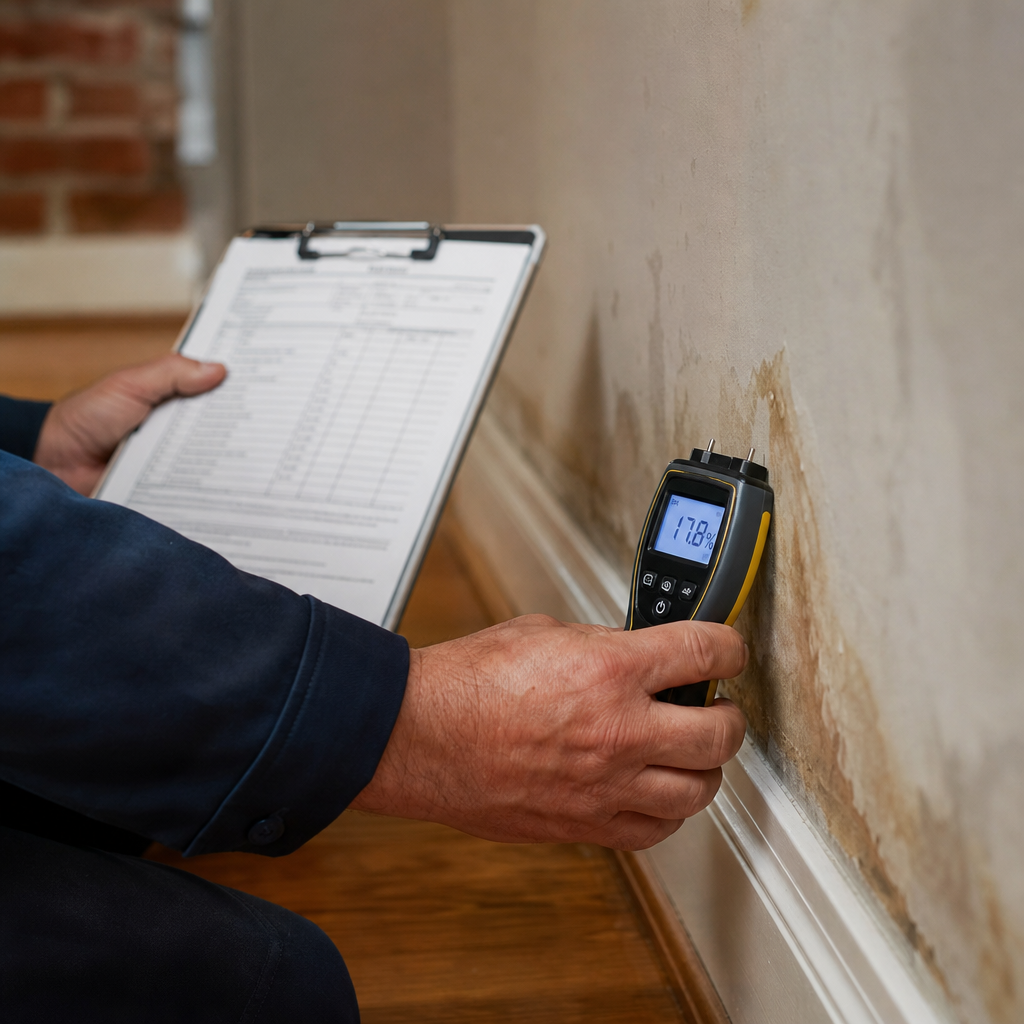
Lateral party-wall moisture migration happens when water wicks sideways through porous, shared brick structures between attached buildings through capillary action. In attached Flushing row homes, standing water soaks into double-wythe masonry and structural floor joist pockets, spreading hidden structural rot and mold to the building next door unless treated with specialized drying equipment.
Pre-1950s attached masonry vs. freestanding drying methods
Drying an attached brick building in Queens demands a different technical approach than drying a standalone suburban home. Standalone houses release moisture outward through exterior perimeter walls. Pre-1950s row houses, by contrast, share continuous multi-wythe brick party walls assembled with soft, highly porous lime-based mortar. When ground-level flooding or sewer backups fill one basement, capillary draw pulls water horizontally straight through the brick.
Under IICRC drying principles, water trapped deep inside dense masonry takes significantly longer to release without targeted heat and positive airflow compared to standard open stud walls.
| Structural Feature | Freestanding Frame Homes | Pre-1950s Attached Brick Row Homes |
|---|---|---|
| Wall Cavity Dynamics | Independent stud bays with isolated exterior sheathing | Shared double-wythe party walls with embedded timber joists |
| Moisture Movement | Vertical settling and direct subfloor pooling | Lateral capillary wicking across shared property lines |
| Drying Methodology | Standard air movers and ambient dehumidification | Positive-pressure cavity injection and directional heat drying |
Hidden moisture pockets behind shared party walls
Surface drying often fails in Queens row homes because water sits trapped inside structural brick cores and joist pockets. When wood floor joists rest inside damp masonry pockets, lingering moisture causes rapid fungal decay and wood rot. We avoid unnecessary demolition by sending IICRC-certified technicians equipped with calibrated FLIR thermal cameras and deep-penetrating pin meters. These diagnostic tools locate the exact boundary of moisture without needlessly gutting historic plaster or intact drywall.
Preventing cross-property mold and timber rot
When Category 3 sewer water or storm runoff penetrates a party wall, mold spores can activate within 24 to 48 hours, sending airborne particles into neighboring homes. Containing the issue requires a focused three-step approach:
- Moisture perimeter mapping: Non-invasive meters and infrared cameras trace how far water has traveled along the shared wall assembly.
- Negative pressure containment: HEPA air scrubbers create continuous negative pressure, preventing airborne mold spores and sewer bacteria from drifting into adjacent living areas.
- Targeted cavity drying: High-static pressure injection systems push warm, dry air straight into brick recesses and floor joist pockets to pull out trapped dampness.
Calling an experienced team like Floodline Restoration Co. right after a flood ensures shared structural components are inspected, disinfected, and dried to verified standards before structural decay can begin.
What Does Water Damage Restoration Cost in Flushing, NY?
Need water damage restoration in Flushing?
We’re available now - call for a fast, free estimate.
Water damage restoration in Flushing generally ranges from $1,200 to $4,500 for standard water extraction and structural drying in a single room. Complex sewer backups or larger mold remediation projects typically fall between $2,000 and $10,000. Full property restoration involving extensive structural repairs can run from $3,000 to $15,000, with most qualifying costs covered by property insurance.
Flushing water restoration cost breakdown
The cost of mitigation in Queens depends on the cleaniness of the water and the building construction. A clean water supply line leak (Category 1) requires straightforward extraction and air movement. A sewer backup (Category 3) involves hazardous biohazard cleanup, sanitization, and strict containment. Local factors like attached wall structures and city sewer surcharges also influence the final scope of work.
| Feature | Clean Water (Category 1) | Attached Row Home (Party Wall) | Black Water / Sewer (Category 3) |
|---|---|---|---|
| Typical Cost Range | $1,200 – $2,800 | $2,500 – $6,500 | $3,500 – $9,500+ |
| Average Drying Time | 2 – 3 Days | 3 – 5 Days | 4 – 7 Days |
| Specialized Equipment | Air movers, standard LGR units | High-static injection, desiccant units | Negative air units, HEPA scrubbers |
| Porous Material Removal | Minimal | Targeted baseboard access holes | Mandatory disposal of porous items |
What drives mitigation versus reconstruction expenses
The total price tag splits between emergency mitigation (extracting standing water and drying the structure) and structural reconstruction (repairing drywall, flooring, and carpentry). In Flushing row houses, drying the party wall early stops moisture from rotting the timber ends resting in the brickwork. Ignoring hidden dampness causes remediation costs to climb quickly within 48 to 72 hours.
Some contractors quote vague flat estimates over the phone, only to tack on equipment rental fees once the work starts. We protect our customers by sending certified technicians who provide a thorough visual inspection and a detailed, line-item Xactimate estimate. Standardized unit pricing gives you transparent costs for extraction, biohazard disinfection, and drying equipment before any work gets underway.
Acting fast keeps demolition to a minimum. Direct insurance billing paired with detailed daily drying logs helps ensure your claim gets approved without unexpected out-of-pocket costs.
Insurance Billing and Structural Rebuilding for Queens Properties
Managing insurance billing and structural repairs for Queens properties works best through direct carrier coordination supported by daily psychrometric logs, followed by an immediate shift into repair work. Running the entire claim under one roof prevents insurance adjusters from disputing charges or pushing liability between different contractors.
Direct insurance carrier coordination
Insurance adjusters require hard documentation before releasing payments, especially when water has traveled into shared party walls. Through our Straight Claim Program and our Dry Line Standard quality protocol, we supply adjusters with complete digital files that streamline claim approval:
- Thermal imaging records: Proving the exact moisture spread behind walls beyond what is visible on the surface.
- Daily drying logs: Recording ambient temperature, relative humidity, and grains per pound (GPP) to prove the building reached industry dry standards.
- Itemized line-item billing: Writing estimates directly in Xactimate to match carrier pricing guidelines and avoid payment disagreements.
According to insurance industry data, water damage and pipe freezing account for roughly one in four property loss claims. Thorough, professional documentation ensures your claim moves forward without delays.
The benefit of a single-source mitigation and rebuild team
Hiring a mitigation crew that pulls their blowers and leaves puts the burden back on you to find carpenters, drywallers, and painters. If a general contractor builds over framing that was never properly dried, hidden moisture causes mold to grow behind your fresh drywall.
Our single-source model handles the entire project with our own staff from start to finish. Once emergency water extraction and drying wrap up, our team repairs subfloors, hangs drywall, matches trim, and applies finished paint. This unified workflow ensures your property is completely dry before new construction materials seal the walls, giving you a smooth, stress-free return to pre-loss condition.
Frequently Asked Questions About Water Damage in Flushing
Water restoration in Flushing demands equipment and techniques built for coastal high water tables, street sewer surges, and attached brick architecture. Removing active moisture within 24 to 48 hours protects your building from structural decay, mold colonization, and damage to neighboring properties.
Does homeowners insurance cover basement flooding?
Standard homeowner policies typically cover sudden, internal pipe breaks, but they usually exclude ground water seepage or municipal sewer backups unless you have added specific riders to your policy. Because even an inch of standing water can cause substantial structural damage, we log daily moisture readings and submit detailed records directly to your insurance company to help maximize your eligible coverage.
How do I prevent mold growth after an indoor flood?
Stopping mold growth requires bringing indoor relative humidity below 50% within 48 hours of the flood event. Because attached Flushing row homes do not dry easily through exterior walls, crews must dry deep structural cavities directly. Our IICRC-certified technicians use commercial LGR dehumidifiers and apply botanical antimicrobials to eliminate mold spores before they can establish colonies.
How are commercial sewer backups handled?
Properties near the Flushing waterfront regularly deal with Category 3 black water backups during intense coastal storms and municipal sewer surcharges. Cleaning up these biohazards requires containment barriers, heavy extraction, and commercial antimicrobial sanitization. Our crews handle the entire cleanup process across Flushing, Murray Hill, Auburndale, Linden Hill, and Queensboro Hill.
Do not let standing water weaken your building or threaten your health. Call Floodline Restoration Co. on our 24/7 live dispatch line now for guaranteed 45-minute on-site arrival and a detailed property inspection.
Need water damage restoration in Flushing?
We’re available now - call for a fast, free estimate.
Frequently Asked Questions
What happens if floodwater in my Flushing row home migrates through the brick party wall into a neighbor's property?
When moisture wicks laterally through shared masonry, Floodline Restoration Co. uses non-invasive infrared thermal mapping to establish the exact moisture boundary across property lines. Our technicians deploy negative-air containment to block cross-contamination and generate separate, insurer-compliant drying logs for each affected property to streamline dual-home claims.
Which materials can be saved versus replaced after a Category 3 sewer backup?
Hard, non-porous surfaces such as structural timber joists, masonry foundations, and concrete subfloors can be fully sanitized and salvaged through EPA-registered antimicrobials and deep extraction. Highly porous materials, including saturated drywall, baseboards, carpeting, and fiberglass insulation, must be removed and safely discarded under IICRC S500 protocols. Floodline Restoration Co. inventories all discarded items into an itemized contents loss report for your insurance carrier.
How does Floodline Restoration Co. manage direct insurance billing during water damage repairs?
Through our Straight Claim Program, our team prepares itemized estimates using carrier-standard Xactimate software and supports every scope item with FLIR thermal scans and daily moisture logs. We submit these complete digital files directly to your insurance adjuster, ensuring billing transparency and eliminating unexpected out-of-pocket payment disputes.
About the author
 |
Sarah Miller Sarah Miller is a certified water damage restoration specialist with over 8 years of experience working with residential and commercial properties in the New York area. She holds a B.S. in Environmental Science from SUNY College of Environmental Science and Forestry and is passionate about helping property owners navigate emergency situations and prevent long-term damage. |
Water damage, flood, or mold emergency?
We’re available now - call for a fast, free estimate.
Call Now - Free Estimate