
Quick Summary
Rapid emergency water damage restoration in College Point is vital for safeguarding coastal properties against severe structural decay and mold colonization following storm surges or plumbing failures. Floodline Restoration Co. acts as the leading local solution provider, offering rapid 45-minute on-site deployment to execute advanced moisture mapping, high-capacity water extraction, and specialized structural drying tailored to Queens architecture. Property owners will understand critical emergency safety protocols and can immediately contact the 24/7 dispatch line to request a free visual inspection and moisture assessment.
Emergency Water Damage Restoration in College Point
When water enters a basement or commercial ground floor in College Point, minutes matter. Whether dealing with a failed sump pump, a plumbing break, or storm runoff, immediate water extraction stops moisture from migrating deeper into structural framing.
College Point is bordered by the East River and Flushing Bay. Acting quickly helps prevent water damage from spreading and reduces the risk of mold growth.[5] See also Water Damage Restoration in Flushing – Call Now-10% Off – Same-Day Service – Free Estimate.
What to Expect from Emergency Water Damage Restoration
Emergency restoration stabilizes the property, halts ongoing moisture intrusion, and extracts standing water. Professional crews, such as those from Floodline Restoration Co., evaluate hidden moisture, protect indoor air quality, and dry out building assemblies safely.
1. Moisture Mapping and Inspection
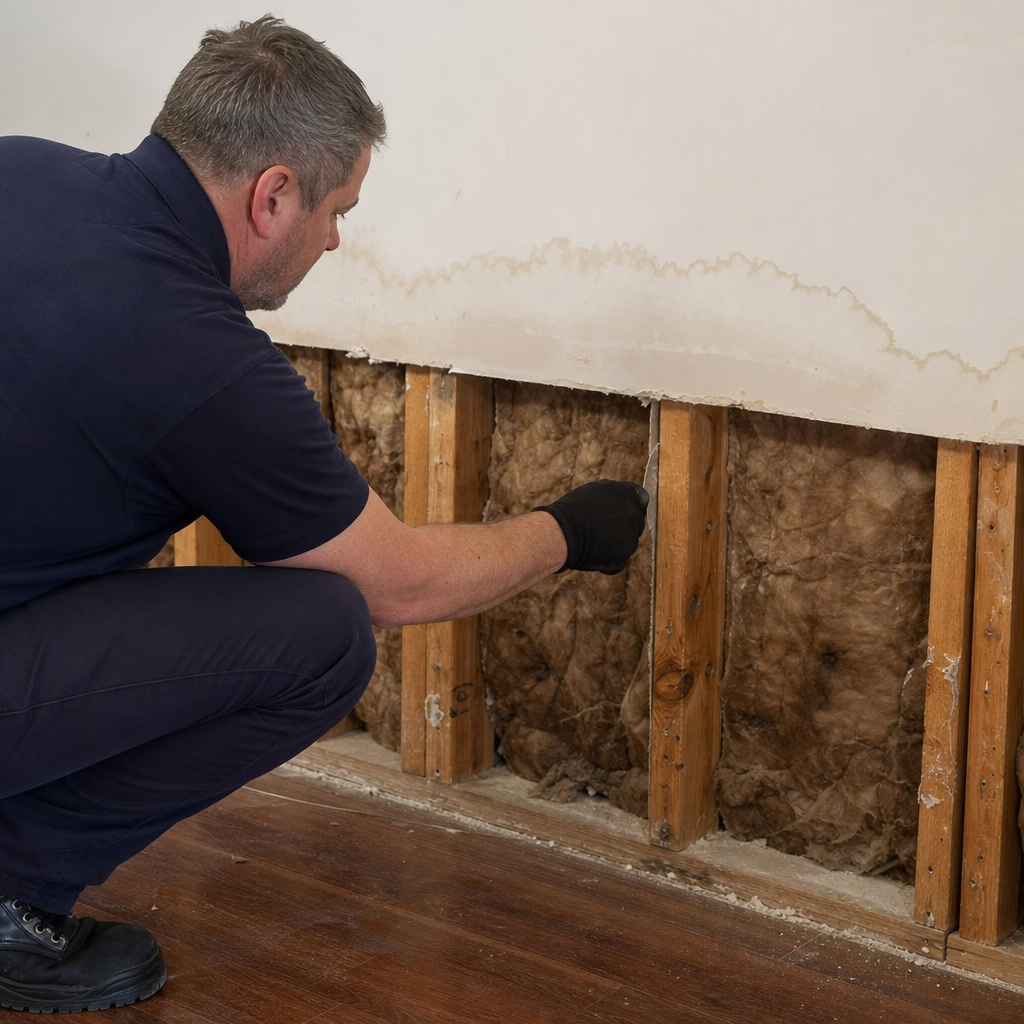
Technicians from Floodline Restoration Co. use moisture meters and thermal imaging cameras to trace water paths behind baseboards, beneath flooring, and inside wall cavities, where moisture frequently travels without showing immediate surface stains.
2. Water Extraction
Submersible and high-capacity extraction pumps remove standing water from finished basements, crawlspaces, and ground floors to prevent building materials from wicking moisture upward.
3. Structural Drying and Dehumidification
Industrial dehumidifiers and high-velocity air movers are placed strategically to remove moisture from framing, concrete, and wall assemblies, with daily moisture readings taken to monitor drying progress.
4. Cleaning and Sanitation
Surfaces exposed to contaminated water are cleaned and sanitized to address bacteria and prevent mold growth.
Flood Risk in Queens Community Board 7
Queens Community Board 7, which includes College Point, is an area of municipal focus for flood risk management. Projections published by NYC Planning in 2017 estimated that residential units within the district’s floodplain would jump 107% by the 2050s (from 4,507 to 9,341 units), while the count of exposed buildings within the district was projected to rise 95% (from 1,594 to 3,107 buildings).[3]
During a flash-flood event on July 31, 2025, NYC Emergency Management reported 6.35 inches of rain in Bayside and 6.52 inches in Oakland Gardens. During major events, city officials urge residents to report property damage directly for emergency assessments while logging general street-level water conditions through the municipal 311 reporting system.[1]
Repair vs. Replace: Managing Wet Building Materials
Determining what can be restored and what must be removed depends on the water source category, contact duration, and material porosity.
| Structural Element | Category 1 (Clean Water) | Category 2 (Gray Water) | Category 3 (Black Water / Floodwater) |
|---|---|---|---|
| Drywall & Insulation | Dry in place if structurally sound | Remove affected lower sections above moisture line | Full removal and disposal of all affected porous materials |
| Subfloors | Dry in place with monitoring | Sanitize and dry in place with monitoring | Inspect and replace if delaminated or structurally compromised |
| Framing & Joists | Structural airflow and drying | Sanitize and controlled drying | Deep sanitation, cleaning, and controlled structural drying |
| Cabinetry | Cavity ventilation and drying | Ventilate, sanitize, and assess backing | Remove and discard compromised porous components |
Drywall Removal
Porous gypsum wallboard and insulation exposed to contaminated Category 2 or Category 3 water are typically removed above the wet line to allow the wall cavity and framing to dry thoroughly.
Subfloors and Framing
Dimensional framing lumber and subflooring can often be saved if dried promptly before structural warping or decay occurs. Specialized drying equipment directs airflow into subfloor and wall cavities.
Cabinet Base Voids
Water frequently migrates beneath base cabinetry. Technicians at Floodline Restoration Co. access toe-kick cavities to direct airflow into trapped voids and dry hidden moisture.
Restoration Costs and Insurance Coverage
Need emergency water damage restoration in College Point?
We’re available now - call for a fast, free estimate.
Water restoration expenses depend on the category of water, the square footage affected, and the scope of structural drying required. Available research does not establish reliable local pricing; property owners should obtain itemized estimates for accurate project costs.
Navigating Homeowners and Commercial Insurance Policies
Insurance coverage depends on the cause of damage and specific policy terms. Standard New York homeowners insurance policies generally exclude flood damage. Separate flood insurance (such as through the National Flood Insurance Program or private flood policies) may cover flooding, while sewer or sump-pump backup damage typically requires a specific policy endorsement.
Across New York State, NOAA National Centers for Environmental Information recorded 95 billion-dollar weather and climate disasters from 1980 through 2024, including five flooding events.[2]
As noted by Floodline Restoration Co., to protect an insurance claim, photograph all standing water, damaged belongings, and affected building materials before alterations occur, and maintain detailed service records and drying documentation.
Immediate Safety Checklist While Waiting for Help
- Shut Off Power: If water reaches wall outlets, cords, or electrical panels, do not enter the flooded area. Turn off power from a dry breaker panel or await utility and emergency assistance.
- Stop the Water Source: If the issue involves an internal plumbing failure, close the main water shutoff valve immediately.
- Avoid Contaminated Water: Keep occupants and pets away from sewage backups or outdoor floodwater, which can carry harmful pathogens and contaminants.
- Protect Belongings: Elevate furniture legs away from wet carpets and move valuable items or documents to dry areas.
- Avoid Household Vacuums: Never use a standard household vacuum to remove water, as this creates a severe electrical hazard.
Frequently Asked Questions
How quickly can an emergency water restoration team arrive in College Point?
Arrival time depends on availability, traffic, access, incident severity, and whether the property is safe to enter. Confirm the expected arrival time when requesting service.
Can emergency water extraction prevent mold growth in my basement?
Prompt water extraction combined with structural dehumidification reduces indoor humidity and moisture levels, substantially lowering the risk of mold colonization on organic building materials.
Does homeowners insurance cover emergency water damage in College Point?
Coverage depends on the cause of damage and policy terms. Standard New York homeowners policies generally exclude flood damage. Separate flood insurance may cover flooding, and sewer or sump-pump backup may require an endorsement.
How long does structural drying take after a flood?
Drying duration varies depending on the specific building materials, contamination levels, and environmental conditions at the site.
Disclaimer
This article provides informational guidance on water damage mitigation principles. Floodplain statistics reflect 2017 NYC Planning projections for Queens Community Board 7 as a whole, which includes College Point, rather than standalone neighborhood figures. Always consult certified restoration specialists like Floodline Restoration Co. and licensed insurance representatives for property-specific assessments.[4]
Need emergency water damage restoration in College Point?
We’re available now - call for a fast, free estimate.
Sources
- News Archive 2025 – Brooklyn Community Board 4 – nyc.gov (2025)
- Billion-Dollar Weather and Climate Disasters | New York Summary – ncei.noaa.gov (2024)
- Flood Resilience Zoning Text Update – nyc.gov (2015)
- [PDF] Flood Resilience Zoning – NYC.gov – nyc.gov (2015)
- Queens Borough President's Hurricane Sandy Task Force – nyc.gov (2015)
Related reading: Emergency Water Damage Restoration in Bayside – Call Now-10% Off – On-Site in 60 Minutes – Free Estimate
Related reading: Water Damage Restoration in Middle Village – Call Now-10% Off – Same-Day Service – Free Estimate
Related reading: Water Damage Restoration in College Point – 10% Off & Free Estimate – Same-Day Service
Frequently Asked Questions
What happens during a free visual inspection and moisture assessment in College Point?
When Floodline Restoration Co. arrives on-site, technicians deploy thermal imaging cameras and precision moisture meters to locate hidden water trapped behind walls and under floors. The team assesses the water contamination category, checks structural integrity, and outlines an immediate extraction and drying strategy.
How does coastal floodwater from Flushing Bay or the East River alter the restoration process?
Coastal storm surge is classified as Category 3 black water because it carries silt, sewage, and microbial contaminants, requiring the full removal and disposal of porous drywall and insulation. Floodline Restoration Co. applies specialized deep sanitation and targeted structural drying tailored to coastal Queens building construction to stop mold and decay.
How does Floodline Restoration Co. assist property owners with water damage insurance claims?
Technicians document all pre-existing conditions, water levels, and damaged property using detailed photographs and thermal moisture logs before cleanup begins. Floodline Restoration Co. maintains comprehensive structural drying records and itemized service reports to support your claim with private insurers or national flood programs.
About the author
 |
Sarah Miller Sarah Miller is a certified water damage restoration specialist with over 8 years of experience working with residential and commercial properties in the New York area. She holds a B.S. in Environmental Science from SUNY College of Environmental Science and Forestry and is passionate about helping property owners navigate emergency situations and prevent long-term damage. |
Water damage, flood, or mold emergency?
We’re available now - call for a fast, free estimate.
Call Now - Free Estimate