
How to Choose the Right Damage Restoration Company in Flushing
Choosing the right damage restoration company in Flushing means asking one question most homeowners skip: who finishes the job? A company that extracts water and then hands you a list of subcontractors has already walked away from the hard part. You want one crew, one phone number, and one written promise that covers the work from first extraction to finished rebuild. If you’d rather skip the homework and talk it through, call (518) 872-6111 and we’ll walk you through it.
In Queens, it’s completely legal for a “full-service” restoration company to extract your water, hand you a dry certificate, and walk away, leaving you to find your own contractor for the gutted walls and pulled flooring they left behind. Most homeowners discover this only after they’ve already signed. This guide is built to make sure you know what to ask before you sign anything.
Key Takeaways for Flushing Homeowners
- The most consequential question isn’t “are you licensed?” It’s “do you finish the rebuild, or do I find someone else?”
- Verify four credentials: IICRC WRT and ASD, NYS contractor license, and liability coverage for both mitigation and reconstruction.
- Ask to see a sample moisture log before you sign. A contractor who can’t explain drying targets is showing you a red flag.
- Direct insurance billing isn’t a convenience perk. It means the contractor answers to the adjuster’s scope, not just to you.
- Require a written post-completion warranty covering latent moisture damage, not just visible repairs.
Ask Who Finishes the Rebuild Before You Ask Anything Else
Most advice about choosing a restoration company in Flushing starts with licensing and reviews. Those matter, but they’re table stakes. The question that separates a full-cycle company from a handoff operation is simpler: what happens after the drying is done?
Here’s the scenario we see too often. A homeowner in Flushing wakes up to a failed supply line under the kitchen sink. They call a restoration company. The crew arrives, extracts the water, sets up fans and dehumidifiers, and three days later hands over a dry certificate. Then comes the surprise: the same company doesn’t do reconstruction. The homeowner now has to find a separate contractor to replace drywall, flooring, and baseboards. That contractor didn’t see the moisture map from day one. They don’t know what was wet behind the walls. They bill separately. And when something goes wrong, each company points at the other.
The fix is to ask a direct question before you sign: “Does your written scope of work include reconstruction as a deliverable, or does it end at dry-out?” Listen for the word “partner” or “we work with a great contractor.” That’s a handoff wearing a nicer name.
At Floodline Restoration Co. home, the same certified crew that reads the moisture map on day one handles daily readings, hands the log to the homeowner and carrier, and rebuilds what needs rebuilding. No mid-job handoff, no inherited crew, no phone tag between two companies. That’s the whole point of starting at the floodline and staying until the finish work is done.
Four Credentials That Actually Matter in New York, and How to Verify Them in Under Five Minutes
A lot of contractors in Flushing will tell you they’re certified. Some of them are. Here are the four credentials that matter for a damage restoration job in New York, and how to check each one quickly.
1. IICRC WRT and ASD Certifications
The Institute of Inspection, Cleaning and Restoration Certification sets the industry standards for water damage work. WRT stands for Water Restoration Technician. ASD is Applied Structural Drying. These two certifications together mean the technician understands how water migrates through building materials and how to dry a structure to an actual target moisture content, not just until things feel dry to the touch.
To verify, ask the company for the technician’s IICRC certification number. You can check it online through the IICRC’s certification registry in about a minute. A company that hesitates to provide a cert number is telling you something.
2. NYS Contractor License
A general contractor performing restoration and reconstruction work in New York needs the appropriate state and local licensing. Ask for the license number and verify it with the issuing agency. This isn’t optional for rebuild work, and any company that brushes past the request deserves a harder look.
3. Liability Coverage for Both Mitigation AND Reconstruction
This is the one most people miss. A company might carry liability insurance for water extraction and drying, but not for the reconstruction phase. Ask specifically: “Does your liability policy cover the rebuild work, or just the mitigation?” If they only carry coverage for water extraction, you’re the one holding the bag if something goes wrong with the drywall work later.
4. Workers’ Compensation Coverage
Restoration work involves heavy equipment, water, and sometimes structural instability. If a crew member gets injured on your property and the company doesn’t carry workers’ comp, you could be looking at a claim against your own homeowners insurance. Ask for a certificate of insurance that names you as the certificate holder. It takes the company’s agent one email to send it.
How to Evaluate a Moisture Log as a Competency Signal
Here’s a conversation you can have during the estimate visit that will tell you more about a restoration company than any review page.
Ask this: “Can you walk me through the drying targets you’ll hit, and by when?”
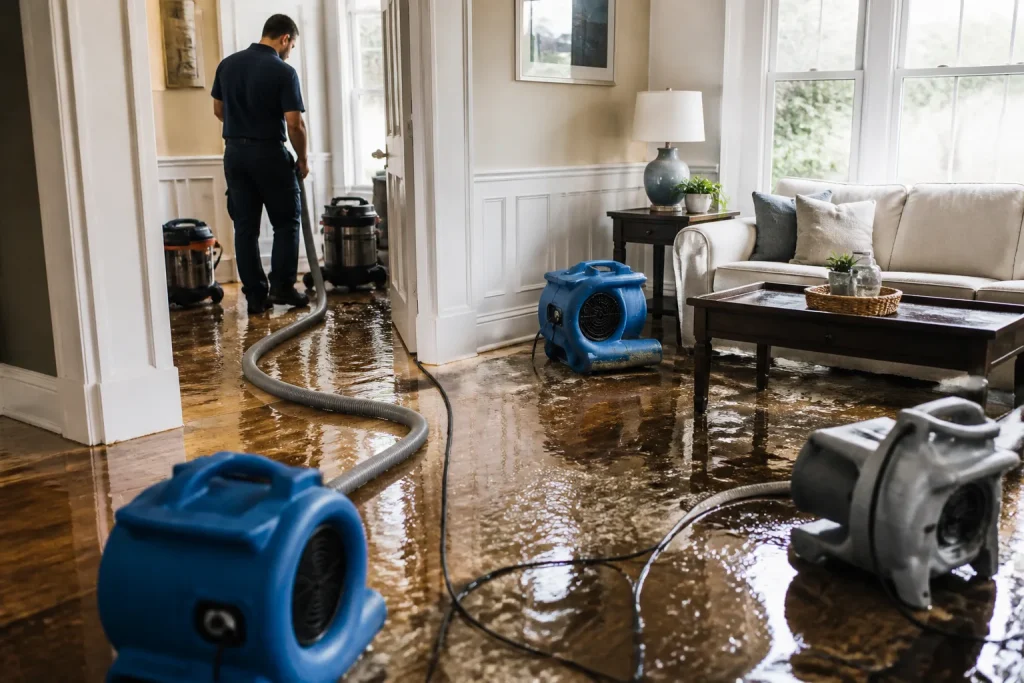
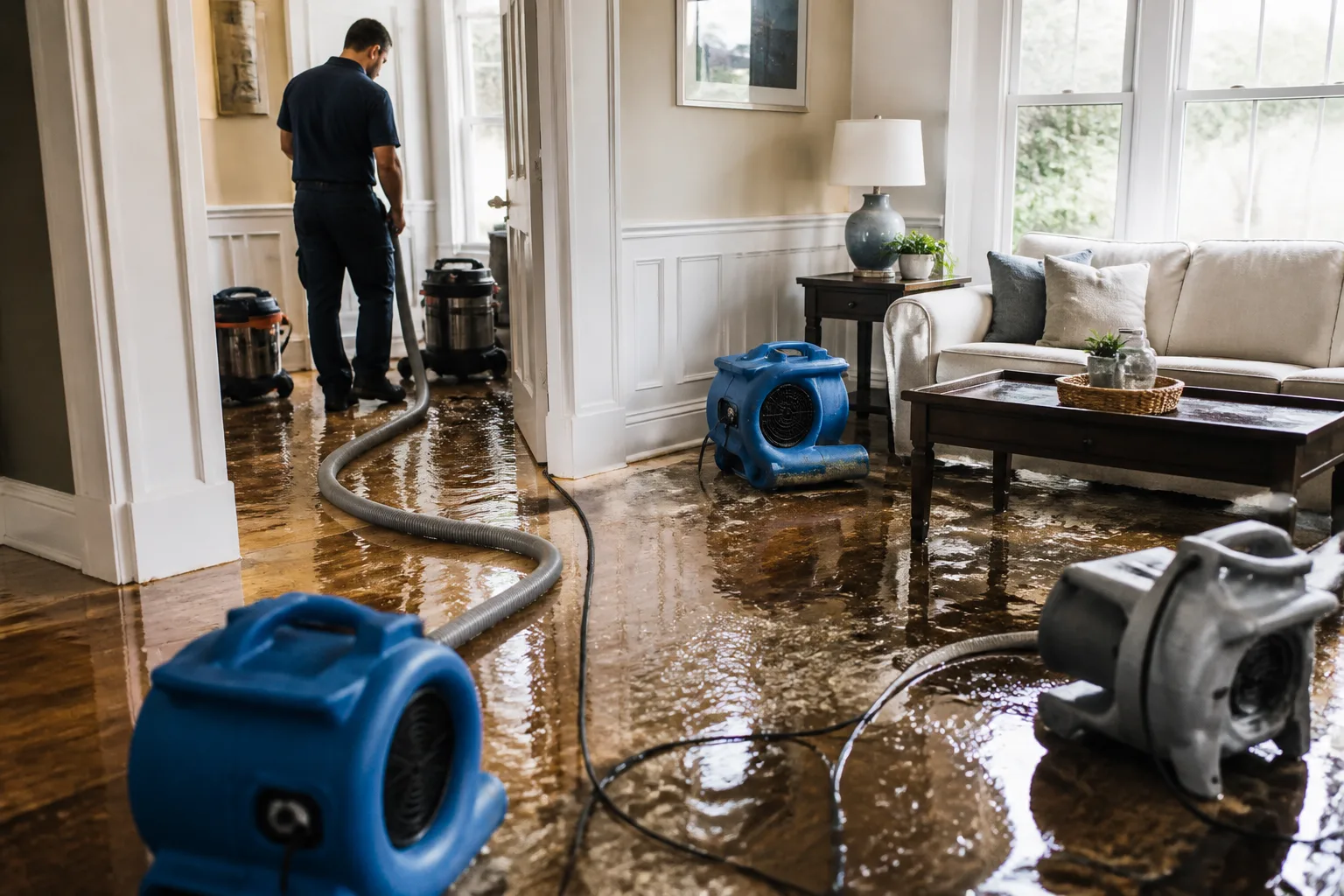
A competent water damage restoration company in Flushing will answer with specifics. They’ll talk about the moisture content of the affected materials, the target dry standard, and the daily readings they’ll log until the structure reaches that standard. They’ll explain that they use professional-grade equipment like Dri-Eaz and Phoenix dehumidifiers, with air movers positioned to drive moisture out of wall cavities and subflooring. They might mention an Injectidry system for hard-to-reach spaces like under cabinets or behind tile.
A less competent company will tell you not to worry about it. “It’ll be dry in three or four days.” “We’ve done this a thousand times.” “You don’t need to see the log.”
You do need to see the log. The moisture log is the closest thing you have to objective proof that the job was done right where you can’t see it, which is exactly where latent moisture damage likes to hide. In Water Damage Restoration in Flushing work, the difference between a structure that’s truly dry and one that just feels dry is documented in daily moisture readings, not in how quickly a crew packed up and left.
Why Direct Insurance Billing Is a Bigger Deal Than It Sounds
“Direct insurance billing” is one of those phrases that sounds like a convenience feature, the restoration equivalent of free shipping. It’s not. It’s a structural difference in how the contractor is accountable for your money.
Here’s how it works. When a restoration company bills your insurance carrier directly, the contractor is working against the adjuster’s written scope of loss. That means the adjuster has agreed in advance to what’s covered, what’s not, and what line items the carrier will pay for. If the contractor finds something mid-job that falls outside the original scope, they have to work it out with the adjuster before they bill you for the difference.
When you pay out of pocket and chase reimbursement yourself, you’re the one playing messenger. You’re the one reading a denial letter at 9 p.m. trying to figure out what “not covered under ALE” means. You’re the one calling the carrier, then calling the contractor, then calling the carrier again.
At Floodline Restoration Co., we bill the carrier directly, and the homeowner never plays messenger between us and the adjuster. That’s not a marketing line. It’s how the paperwork moves. If you’re dealing with a sewage backup in your Flushing basement, the last thing you need is a second job as a claims administrator. For Mold Remediation in Flushing work especially, where documentation and scope compliance matter to both the carrier and the homeowner, direct billing keeps the whole thing straight.
The Written Guarantee to Require Before You Sign Anything
Every restoration company in Flushing will tell you they do good work. Some of them will put it in writing. Almost none of them will put the one thing in writing that actually matters after the invoice is paid.
Ask for a post-completion warranty that explicitly covers latent moisture damage, not just visible workmanship.
Here’s the difference. A workmanship warranty says: if the drywall we hung cracks, we’ll fix it. That’s fine, as far as it goes. Latent moisture damage is the thing that shows up six months later, when mold blooms behind a baseboard that looked perfectly dry at day 10. By then, most contractors are long gone, and the fine print says the warranty ended at 30 days.
A 90-day written guarantee that covers latent moisture issues changes the economics of the decision. It means the contractor has a financial incentive to dry your home to the actual dry standard, not to the “dry enough” standard. It means if something was hidden in a wall cavity and shows up weeks later, you have a written promise to lean on without a paperwork battle.
We call our version the 90-Day Done Right Promise, and we give it in writing on every job. It’s tied to a values code we call K.E.Y.S.: Krafted right, Every time, Your home first, Standing behind it. If it’s not done right, we make it right. No arguing.
What This Looks Like in a Real Flushing Home
Last winter we pulled a job out of a 1950s brick row house over in East Flushing. A radiator supply line had let go in the living room while the homeowner was visiting family upstate. By the time a neighbor noticed water pushing under the front door, it had been running for nearly 48 hours.
The water had wicked up the plaster walls and under the hardwood in two rooms. We extracted over 200 gallons that first night. We set up commercial dehumidifiers from Phoenix and high-velocity air movers from XPOWER, and we took moisture readings every day for nine days until the structure hit the dry standard. Then we replaced the hardwood, rebuilt the plaster walls, and matched the baseboard profile to the rest of the house, because that’s what a 1950s Flushing row house deserves.
The point of that story isn’t the equipment, though it helped. The point is that there was exactly one company on the job, one moisture log handed to the carrier, one bill, and one written promise. The homeowner didn’t make a single phone call to a sub.
When you’re choosing a restoration company in Flushing, ask who finishes the job. Then make them put it in writing.
The Bottom Line
Most advice about picking a restoration contractor skips the question that actually predicts how your experience will go: does the company finish the rebuild, or do you? In Flushing, it’s legal for a restoration company to dry out your house and leave you standing in a gutted living room. Ask the question before you sign. Verify the four credentials that matter: IICRC WRT and ASD, NYS contractor license, liability coverage for mitigation and reconstruction, and workers’ comp. Ask to see a sample moisture log. Understand that direct insurance billing changes who the contractor answers to. And require a written guarantee that covers latent moisture damage, not just visible repairs.
If you’re in Flushing and need help, Fire & Smoke Damage Restoration in Flushing and every other phase of the job is handled by one crew, start to finish. Floodline Restoration Co. offers free estimates. Call (518) 872-6111 and a live person answers, day or night.
Frequently Asked Questions
How do I know if a restoration company does full-cycle work or just mitigation?
Ask for the written scope of work and look for language that names reconstruction as a deliverable, not an optional add-on. If the scope ends at dry-out and the company says they “work with” a contractor for rebuilds, that’s a handoff, not full-cycle service. Ask directly: “Does your crew do the rebuild, or do I find someone else?”
What should a moisture log include?
A proper moisture log is more than a record of daily readings, though those matter most. It includes the initial moisture content readings from each affected material, the target dry standard for each material type, and daily readings showing the progression until materials reach that standard. A company that can’t explain its drying targets before the job is unlikely to stand behind them after.
Will my insurance cover the restoration work?
That depends on your policy, your deductible, and the cause of the damage. Sudden and accidental events like a burst pipe or appliance failure are typically covered. Gradual issues like years of slow leaks may not be. A restoration company that bills your carrier directly can work with your adjuster to align the scope with what the policy covers. You’ll still have your deductible, but you won’t be the one interpreting policy language.
How fast can a restoration company get to a Flushing home in an emergency?
Response time depends on the company and the dispatch model. What matters is whether a live person answers the phone. A recorded message at 2 a.m. means you’re leaving a voicemail and waiting. A live dispatcher means a crew is on the way. Ask any company you’re considering what happens when you call at 3 a.m. on a Sunday. The answer will tell you what you need to know.
Written by Curt Bowman, Owner at Floodline Restoration Co., serving Flushing since 2010.
Need Damage Restoration Help?
Call Floodline Restoration Co. - licensed & insured, here with fast after-hours help in Flushing.
(518) 872-6111