
Quick Summary
Properties vulnerable to coastal storm surges, sewer backups, and plumbing failures require immediate water damage restoration in Throgs Neck to prevent long-term structural decay and hazardous mold growth. Floodline Restoration Co. delivers fast 24/7 emergency mitigation, deploying infrared moisture mapping, specialized desalination for brackish floodwaters, and psychrometric drying supported by comprehensive insurance documentation. Property owners will understand critical initial safety procedures and can contact Floodline Restoration Co. for immediate extraction or a free visual inspection to restore their property safely.
Water Damage Restoration in Throgs Neck
When water intrudes into a Throgs Neck property, immediate mitigation protects the structure from permanent decay. Rapid extraction, psychrometric drying, and precise moisture mapping are essential to stop secondary damage before it spreads. In Bronx Community District 10, an estimated 4,100 residential units currently sit inside vulnerable floodplains, a figure projected to climb past 11,000 in coming decades.[8] Between coastal storm surges along the East River and municipal sewer backups during heavy downpours, local properties face distinct environmental pressures that demand specialized structural drying.[2]
Professional restoration teams like Floodline Restoration Co. stabilize the building envelope through documented, science-backed procedures. Certified technicians track moisture migration through building materials, extract standing water, and provide line-item documentation to help property owners settle insurance claims quickly. See also Water Damage Restoration in Flushing – Call Now-10% Off – Same-Day Service – Free Estimate.
Immediate Steps: What to Do During a Water Emergency
Immediate Action Summary: Protect your safety by shutting off the main water valve and cutting power to wet areas at the breaker box. Avoid contact with standing water if sewage or electrical hazards are present. Call a certified restoration team immediately to begin extraction, and record photo and video evidence of all wet belongings and structural water lines before any water is pumped out.
During an active water loss, safety comes first. If the electrical panel is in a dry location, turn off the circuit breakers controlling flooded rooms. Shut off the main water valve to stop plumbing supply leaks. Avoid walking through standing water, which can carry hidden electrical current or biological contaminants from municipal backflows.[5]
Step-by-step safety checklist before technicians arrive
- Cut utilities safely: Shut down the main water line and disconnect electricity to affected zones. If your breaker box is in a flooded basement, do not enter the water; call your utility company or wait for emergency crews.
- Capture detailed visual evidence: Take wide and close-up photos and videos showing water depth marks against drywall, soaked subflooring, damaged personal contents, and structural materials before mitigation starts.
- Protect contents from capillary wicking: Place aluminum foil or plastic wrap under wooden furniture legs resting on damp carpet or concrete to prevent permanent wood stain transfer.
- Dispatch emergency restoration: Contact an emergency crew to set up containment and start physical extraction before water wicks higher into wall cavities.
According to Waterfront Alliance data for Bronx Community District 10, over 4,100 residential units sit in low-lying coastal flood zones.[8] Near Long Island Sound, Eastchester Bay, and the Throggs Neck Bridge approaches, getting water out quickly prevents brackish floodwater from depositing salt crystals deep inside concrete block and fieldstone foundations.[3]
How Coastal Flooding and Hydrostatic Pressure Damage Local Foundations
Need water damage restoration in Throgs Neck?
We’re available now - call for a fast, free estimate.
Properties along Pennyfield Avenue, Shore Drive, and surrounding coastal avenues encounter intense hydrostatic pressure during severe weather and astronomical high tides. When groundwater rises around a foundation, thousands of pounds of pressure force water through hairline cracks, mortar joints, and porous concrete slabs.
NYC Hazard Mitigation data indicates that roughly 60 percent of buildings in the city’s 1 percent annual chance floodplain risk damage during major inundation events. In the Bronx alone, base flood models show over 1,400 structures exposed to severe inundation. When Hurricane Ida swept across the region, it produced widespread flooding across every borough, demonstrating that even inland blocks and finished basements are vulnerable to severe hydraulic backup.[12][1]
The hidden threat of brackish moisture and salt crystallization
Standard inland drying techniques fail in coastal Bronx properties because seawater carries dissolved minerals and chlorides. When floodwaters recede and liquid moisture evaporates, hygroscopic salt crystals remain trapped inside porous brick, mortar, and poured concrete. These salts continually draw water vapor out of humid coastal air, creating a cycle of persistent dampness known as salt damp.
Left unaddressed, trapped salts expand within the masonry pores (subflorescence), causing surface spalling, crumbling mortar joints, and peeling paint. Removing brackish water damage requires a targeted approach:
- Desalination and mechanical flushing: Controlled rinsing of structural masonry to extract mineral deposits before sealing.
- Deep cavity dehumidification: Industrial dehumidification equipment reduces ambient relative humidity, pulling moisture from deep inside building materials.
- Thermal and psychrometric verification: Tracking daily moisture reduction to confirm structural framing and concrete have reached dry baseline standards.
Restoring Drywall, Subfloors, and Finished Basements
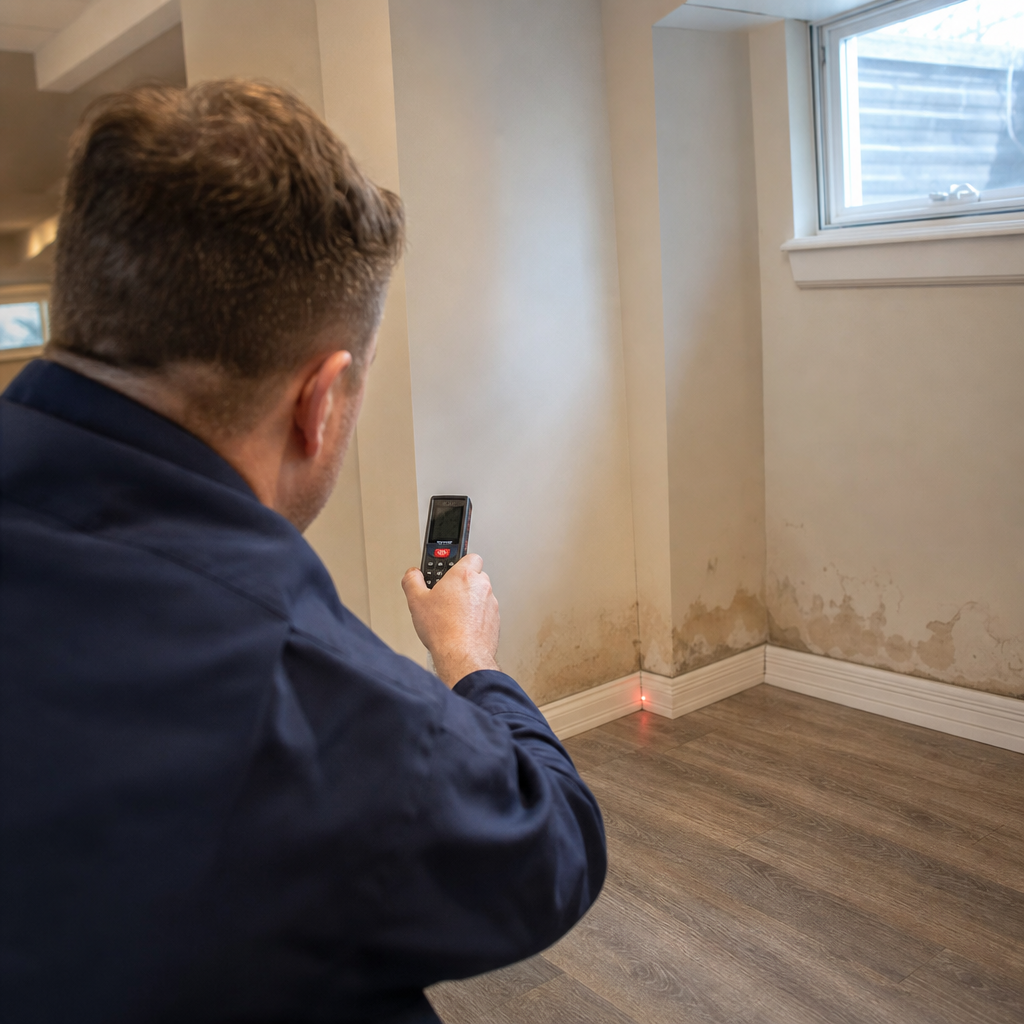
According to Floodline Restoration Co., restoring a water-damaged property involves structural stabilization, microbial containment, and systematic dehumidification. Technicians tailor mitigation methods based on whether the water is clean supply water (Category 1), gray water from appliances (Category 2), or black water from coastal surges and sewer lines (Category 3).[4]
Drywall removal and precision flood cuts
Drywall wicks water upward through cellulose paper facing. For Category 1 clean water leaks, technicians may dry walls in place using directional air movers. For Category 2 or 3 flooding, crews perform clean flood cuts above the highest wet mark. Removing the lower section of drywall and soaked insulation opens the wall cavity, allowing air movers to dry wall framing directly.
Structural drying for subfloors and joists
Plywood, OSB subflooring, and solid hardwood warp and buckle if dried unevenly. Rather than immediately tearing out salvageable flooring, technicians use specialized floor drying systems. These systems pull trapped moisture up through the wood, protecting floor joists and load-bearing framing from rot.
Basement sanitization and sewage decontamination
When sewer mains back up or storm runoff fills a finished basement, the space requires strict biohazard decontamination protocols:
- Porous material removal: Safe disposal of waterlogged carpet, pad, laminate flooring, and wet drywall.
- Antimicrobial application: Washing all exposed masonry, concrete, and framing with EPA-registered disinfectants to neutralize bacterial pathogens.
- Air filtration: Operating HEPA air scrubbers under negative pressure to capture airborne spores, dust, and particulate matter during the drying phase.
Managing Costs and Insurance Claims
Need water damage restoration in Throgs Neck?
We’re available now - call for a fast, free estimate.
Water damage restoration costs in the Throgs Neck area vary depending on the category of water, the volume of structural materials affected, and the degree of structural reconstruction required. Minor clean-water extractions from a localized pipe leak require less extensive remediation, whereas significant basement sewer backups or coastal flood cleanups requiring selective demolition, structural drying, and sanitization involve more extensive labor and equipment.
Standard homeowners and commercial property policies may cover sudden and accidental internal water damage, such as a burst plumbing pipe or supply line failure. However, flood losses usually require separate flood insurance through the National Flood Insurance Program (NFIP) or private flood carriers, and water backup from sewers or drains may require a specific endorsement.
To ensure a straightforward claims process, certified restoration specialists such as Floodline Restoration Co. provide insurers with line-item estimates written in industry-standard platforms, complete with thermal imaging scans, moisture logs, and pre-remediation photo records.
Detecting Hidden Moisture to Prevent Mold Growth
Surface materials often look and feel dry while substantial moisture remains trapped behind baseboards, under subfloors, and within party wall assemblies. Mold spores can germinate within 24 to 48 hours under warm, humid conditions. Locating hidden moisture pockets is essential to prevent secondary microbial contamination.
Thermal imaging and non-destructive mapping
Specialists use infrared thermal imaging cameras to inspect large wall expanses and flooring systems quickly. Because evaporating moisture causes a slight surface temperature drop, thermal cameras display wet areas as distinct cool anomalies. Technicians then verify these anomalies using moisture meters calibrated for specific building materials.
Moisture meter testing methods
Accurate moisture assessment relies on comparing wet structural components against dry standards in unaffected rooms:
| Equipment Type | Operating Mechanism | Primary Application |
|---|---|---|
| Pinless (Non-Penetrating) Meter | Emits electromagnetic radio frequencies up to 0.75 inches deep | Fast, non-destructive moisture scans across hardwood floors, ceramic tile, and finished drywall. |
| Pin-Type (Penetrating) Meter | Measures electrical resistance between two insulated probe pins | Direct structural readings deep inside subfloors, bottom wall plates, wall studs, and joists. |
| Thermo-Hygrometer | Measures ambient air temperature and relative humidity | Tracks drying progress, dew points, and specific humidity in the drying chamber. |
Frequently Asked Questions
How quickly can emergency water restoration crews arrive in Throgs Neck?
Emergency dispatch teams from providers like Floodline Restoration Co. typically respond rapidly across Throgs Neck, Country Club, Pelham Bay, and surrounding East Bronx neighborhoods. Prompt arrival is critical to begin pumping out standing water before it wicks deeper into building framing.
How long does the structural drying and dehumidification process take?
The drying duration depends on the volume of water, affected materials, and atmospheric conditions. Porous masonry basements or structures affected by coastal saltwater intrusion often require extended drying and targeted dehumidification to reach certified dry standard levels.
Does homeowners or renters insurance cover water extraction and repairs?
Coverage depends on the water source and policy terms. Standard policies may cover sudden internal water damage, such as plumbing failures, while flood losses usually require separate flood insurance and water backup from sewers or drains may require an endorsement.
What steps should I take immediately while waiting for water cleanup technicians?
Turn off the main water supply valve and shut down electrical power to affected areas if you can reach the breaker panel safely. Take clear photographs and video recordings of all standing water and damaged items. Do not attempt to run household vacuum cleaners over standing water, and avoid walking through contaminated floodwater or sewage.
How is hidden moisture detected to prevent mold growth after water damage?
Restoration technicians use infrared thermal cameras to spot hidden temperature differences behind walls and beneath flooring. They confirm these readings with calibrated pin-type and pinless moisture meters, tracking structural moisture levels until all materials return to documented baseline standards.
Need water damage restoration in Throgs Neck?
We’re available now - call for a fast, free estimate.
Sources
- Severe Weather Events and Resiliency in New York State – osc.ny.gov (2025)
- [PDF] Eastern Bronx Community Workshop – NYC.gov – nyc.gov (2015)
- Throggs Neck Homeowners Association – September 26, 2017 – nyc.gov (2017)
- A Guide to Hazard Mitigation – nyc.gov
- Hurricane Ida – CDBGDR – NYC.gov – nyc.gov
Related reading: Water Damage Restoration in Throggs Neck – Call Now-10% Off – Same-Day Service – Free Estimate
Related reading: Water Damage Restoration in Middle Village – Call Now-10% Off – Same-Day Service – Free Estimate
Related reading: Water Damage Restoration in College Point – 10% Off & Free Estimate – Same-Day Service
Water Damage Restoration in Nearby Cities
We also serve the communities around Throgs Neck:
- Water Damage Restoration in Astoria
- Water Damage Restoration in Bayside
- Water Damage Restoration in Corona
- Water Damage Restoration in Ditmars Steinway
- Water Damage Restoration in Douglaston
- Water Damage Restoration in East Elmhurst
- Water Damage Restoration in Elmhurst
- Water Damage Restoration in Forest Hills
Frequently Asked Questions
Why is standard drying insufficient for coastal flood damage in Throgs Neck foundations?
Brackish water from Eastchester Bay and the East River leaves hygroscopic salt crystals trapped inside porous concrete and mortar, causing recurring dampness and structural spalling. Floodline Restoration Co. solves this by combining specialized masonry desalination and mechanical flushing with deep cavity dehumidification to eliminate trapped mineral deposits before rebuilding.
How does the Straight Claim Program help Throgs Neck homeowners manage water damage insurance claims?
The Straight Claim Program from Floodline Restoration Co. provides insurers with line-item estimates generated on industry-standard platforms alongside infrared scans, daily psychrometric logs, and visual loss documentation. This organized proof helps differentiate between sudden plumbing leaks, municipal backups, and coastal surges to expedite claims processing.
How high are flood cuts placed on water-damaged drywall during basement restoration?
Flood cuts are typically made 12 to 24 inches above the peak water line to remove contaminated drywall and saturated insulation from wall cavities. Floodline Restoration Co. executes these precision cuts during Category 2 and Category 3 losses to expose framing studs for direct structural drying and antimicrobial treatment.
About the author
 |
Sarah Miller Sarah Miller is a certified water damage restoration specialist with over 8 years of experience working with residential and commercial properties in the New York area. She holds a B.S. in Environmental Science from SUNY College of Environmental Science and Forestry and is passionate about helping property owners navigate emergency situations and prevent long-term damage. |
Water damage, flood, or mold emergency?
We’re available now - call for a fast, free estimate.
Call Now - Free Estimate